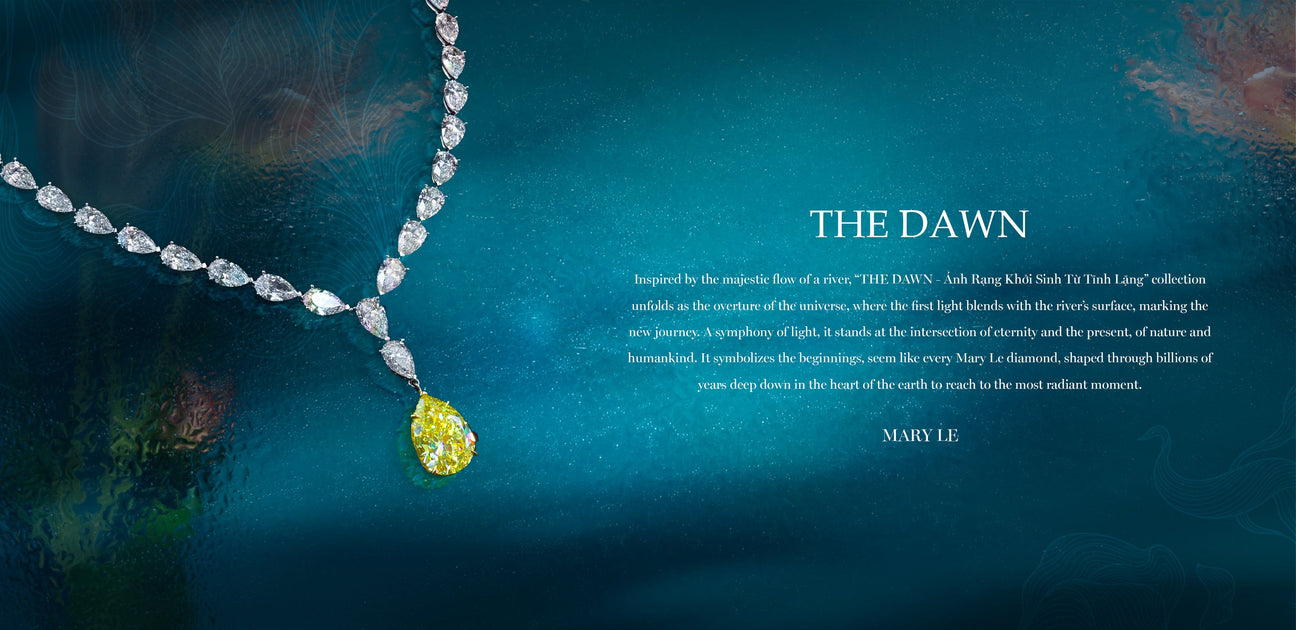


While the 4Cs were once the classic standard of the Gemological Institute of America (GIA) for evaluating diamonds, today, the fifth C – Certification – is the hallmark of trust and true value, affirming the authenticity, origin, and quality of the gemstone.
In the world of jewelry, diamonds are not only admired for their dazzling beauty but also for the rigorous evaluation standards that distinguish an ordinary gemstone from a true masterpiece . These standards are embodied in the new concept of " 5Cs " —an international standard system established by the GIA (Gemological Institute of America) , comprising: Carat (weight), Cut , Color , Clarity, and Certification . (certification).
1. Cut - Cutting edge
Essentially, the cut is how the craftsman shapes and calculates each angle so that light enters, reflects, and exits in the most aesthetically pleasing way. A well-cut diamond will reflect light from the bottom to the top, creating a powerful sparkling effect, a phenomenon that jewelers call "sparkling." brilliance (white light ) fire (color scattering) and sparkle (It sparkles when it moves) .
Conversely, if the cut is even slightly inaccurate, too shallow or too deep, light will leak out instead of reflecting back. In that case, the diamond may lose its brilliance and appear dull, even if the diamond is of high clarity and color on the paper.

GIA assesses cutting quality based on proportions, symmetry, and surface finish, with levels: Excellent , Very Good , Good , Fair , and Poor .
Mary Le always considers the cut to be the key element that gives a diamond its beauty. Each selected stone undergoes rigorous testing for symmetry, brilliance, balance, and light performance. Beyond technical reports, Mary Le's team of experts observes each stone under various light sources—natural light, yellow light, white light—to ensure that when worn, the diamond truly shines.
"Choose the diamond with the best cut you can afford. That's the only factor you can see with the naked eye."
Of all the criteria for a diamond, the cut is the most important factor. It not only determines brilliance, but also shapes emotion , how light moves, and how it reflects the wearer's gaze and story.
2. Color
Natural diamonds form deep within the Earth over billions of years, and in the process, nitrogen or boron atoms can become embedded in the crystal structure. It is these trace atoms that create the color, ranging from colorless to warm yellow , or more rarely , blue, pink, purple, and green.
For colorless diamonds, GIA assigns color grades on the DZ scale , where:
- D: the highest level, completely colorless, absolutely pure.
- E - F: colorless, only different from D under specialized equipment.
- G - J: almost colorless, yet still brilliant when set in jewelry.
- From K onwards: gradually develops a slightly warmer tone, often with a yellowish or light brown tint.

The differences between color grades are very subtle, sometimes imperceptible to the naked eye , but they greatly affect value and rarity. Therefore, a D-color diamond with Flawless clarity and an Excellent cut typically represents the pinnacle of purity that collectors always seek.
However, the definition of "beauty" is not limited to the D-grade ; Mary Le guides clients towards harmonious beauty , where the cut, color, and clarity combine in balance so that the diamond achieves optimal brilliance on the wearer.
Colored diamonds such as pink, blue, yellow, or purple are not included in the DZ scale, but are graded separately by GIA based on three criteria: hue , saturation , and tone , along with grades such as Fancy Light, Fancy, Fancy Intense, Fancy Vivid, and Fancy Deep. Fancy Vivid Pink or Fancy Deep Blue diamonds are often considered by collectors as light legacies – each stone's value far exceeds its carat weight.
At Mary Le, the diamond selection process always prioritizes two factors: visual clarity and color harmony in the cut , because a diamond, no matter how perfect it looks on paper, only truly comes alive when reflected through the wearer.
“Mary Le believes that the color of a diamond is not just a grade, but an emotion. It is the hue of love, of time, and of enduring light.”
The billion-year journey and the birth of yellow diamonds.
Deep within the Earth, where temperature and pressure reach extreme limits, pure carbon crystals are formed over billions of years. But of the countless diamonds born from that journey, less than 0.01% of all diamonds mined globally possess a natural yellow hue, a rare gift from nature created by the presence of trace amounts of nitrogen in the crystal structure. This very element creates a brilliant , warm, and luxurious yellow luster; therefore, each GIA-certified yellow diamond has high collectible value, serving as both an asset and a personal symbol for its owner.
At Mary Le, yellow diamonds are chosen not only for their rarity, but also for the emotional language they convey – brilliance, power, and elegance . Each yellow diamond selected by Mary Le must meet standards of color, purity, and light reflection, ensuring that it shines not only physically but also spiritually. Under the hands of master jewelers, the yellow diamond is awakened, transformed into a masterpiece of light , reflecting the self-assured beauty, class, and confidence of its owner.
3. Clarity - Purity
Diamonds form deep within the Earth, crystallizing over billions of years under immense pressure and temperature. During this process, tiny impurities or natural cracks—called inclusions — or Blemishes (surface imperfections) can appear, directly affecting how light travels through the stone.
The GIA (Gemological Institute of America) has established an international standard purity scale consisting of 11 grades, from Flawless (FL) , which is absolutely flawless, without imperfections even under 10x magnification, to Included (I) , which has visible flaws. Of these, diamonds that meet the Flawless and Internally Flawless standards account for less than 1% of all diamonds mined worldwide, a rare symbol of perfection.

In practice, diamonds with VVS (Very Very Slightly Included) or VS (Very Slightly Included) grades are often considered ideal for balancing value and aesthetics, as they have extremely small imperfections that are imperceptible to the naked eye, yet still maintain high collectible value.
At Mary Le , every diamond is rigorously selected according to VS2 standards or higher , accompanied by transparent GIA certification regarding origin and characteristics, ensuring each gemstone achieves near-perfect purity , allowing for the most natural and powerful light diffusion. Under the hands of skilled artisans, each stone is examined, cut, and polished to stringent standards to achieve not only ideal purity but also artistic sophistication. This clarity reflects a spirit of perfectionism and reverence for natural beauty – a value that Mary Le always pursues in every masterpiece . For in the world of jewelry, purity is not just an evaluation factor , but a symbol of purity, elegance, and inherent power, a light that cannot be faked, only created by time and the hands of an artisan.
4. Carat - Weight
In the language of diamonds, carat (ct) Diamond is a unit of measurement for the weight of a diamond, where 1 carat is equivalent to 0.2 grams . It sounds simple, but that number hides a complex system of values. Size, rarity, craftsmanship, and aesthetic sensibility all combine to create the prestige of each gemstone.
The larger the diamond, the rarer it is. Statistics show that of the millions of carats of diamonds mined each year, only a very small fraction weigh over 1 carat , and the percentage drops sharply beyond 3 or 5 carats. This explains why the value of diamonds doesn't increase linearly with weight but rather exponentially , because the scarcity of large, perfect diamonds is almost naturally impossible to repeat.
For Mary Le , the carat is the heart of the stone , the convergence point of light, energy, and heritage value. This is because the larger the diamond, the more difficult it is to achieve absolute perfection. This rarity makes each large diamond a unique work of art – impossible to copy, impossible to recreate, and utterly irreplaceable.
In Mary Le's High Jewelry designs, carat is not just a technical element but a statement of power and the owner's confidence . Each carefully selected natural yellow diamond, even those weighing 5 carats or more, is meticulously chosen to achieve the "golden ratio" between size and light. When light passes through this large diamond, it not only reflects but also spreads, amplifies, and resonates , creating a unique aura rarely seen even among collectors.
For Mary Le, the carat is the language of eternity, the measure of light and permanence . A 5, 10, or 20-carat diamond is not just an asset, but a part of the history of light, a testament to billions of years of nature's creation and the refined hands of man . Each diamond is chosen not just to sparkle, but to preserve a legacy , so that its light becomes a unique mark of its owner.
5. Certification
The fifth "C" - Certification that is The language of truth, the absolute guarantee of a diamond's value. In the world of jewelry, where every ray of light holds meaning, a diamond is only truly perfect when it is certified by a prestigious international certification, proving its natural origin, quality, and authenticity.
Diamond certificates are considered the "passport" of a gemstone , issued by leading gemological organizations worldwide such as GIA (Gemological Institute of America). Each certificate is a detailed analysis, clearly stating all information about carat weight, color, clarity, cut, and technical parameters such as proportion, symmetry, brilliance, and fluorescence . It also includes a laser-engraved identification number directly on the diamond , allowing for transparent and absolutely accurate traceability.
In today's market, where cultured diamonds are becoming increasingly sophisticated, international certification has become the dividing line between genuine and fake, between value and misconception . A diamond may sparkle under the lights, but only a reputable certification confirms that it is entirely natural and worthy of being passed down through generations . This is why certification is considered the "fifth C," a guarantee that comprehensively defines the value of a diamond.

Source: GIA - Gemological Institute of America
At Mary Le , certification is more than just technical paperwork; it's about... A commitment of honor . Each diamond in the collection comes with a GIA certificate , guaranteeing its natural origin, transparency, and lack of artificial intervention. But more than just numbers, Mary Le believes that Authenticity is the foundation of trust ; it is what elevates a diamond beyond its material value to become a legacy of true light.
In the hands of its owner, a Mary Le diamond not only carries the brilliance of billions of years, but also absolute proof of its originality , which gives it the profound spiritual value of those who truly understand diamonds. Because at Mary Le, every diamond comes with a GIA certificate, each certificate... It not only confirms the quality of the stone, but also confirms the character and aesthetic taste of the person who chooses it .
The significance of the 5Cs standard in diamonds.
In the world of jewelry, the 5Cs are not only an international standard for valuing diamonds but also a common language among craftsmen and collectors . Each "C" reflects an aspect of perfection: from weight, color, clarity, cut to certification. When all five elements are present, the diamond not only achieves material rarity but also possesses aesthetic, technical, and emotional value .
At Mary Le, the 5Cs are the absolute guiding principle in the selection and crafting process. Each diamond is evaluated by the eye of an expert and according to artistic standards, ensuring that only those that reach the pinnacle of brilliance, structure, and intrinsic energy are chosen to become pieces of jewelry. For Mary Le, the 5Cs represent a commitment to absolute refinement and lasting heritage value in every design. Because a diamond that meets the 5Cs standards not only shines brilliantly today but also retains that radiant value for generations to come.