

In the jewelry industry , every standard is measured by near-absolute precision. Flawless (FL) and Internally Flawless (IF) are the two highest grades of purity , representing the concept of "flawlessness" that diamond appraisers always mention. To most customers, "Flawless" may sound like just a fancy term, but in appraisal techniques, it means... The most stringent standard , defined and strictly protected by the Gemological Institute of America (GIA) , represents an almost unattainable ideal state : completely free of any inclusions or blemishes when observed under a 10x magnifying glass.

Owning a Flawless diamond means possessing a geological wonder – where the carbon crystallization process occurs under such perfect conditions that it leaves no trace of imperfections, creating an optimal optical environment for the movement and reflection of light .
Distinguishing between Flawless (FL) and Internally Flawless (IF)
The difference between these two levels lies in the level of meticulous detail that only expert appraisers can identify.
Flawless (FL): At this level, the diamond is certified to be completely free of internal inclusions and surface blemishes under standard 10x magnification. This is the highest clarity grade on the GIA scale and the rarest clarity level found in nature.
Internally Flawless (IF): A diamond is classified as IF when it contains no visible imperfections below 10x; however, some minor surface blemishes may exist. These blemishes, such as surface graining, extra facets outside the original design, or signs of imperfect polishing, can usually be removed through further recutting.
Despite the technical distinction, the difference between FL and IF is almost imperceptible to the naked eye. Their exceptional value lies in their rarity and the guarantee of a near-perfect crystal structure.
Why are Flawless and IF particularly valuable?
“Evaluating diamond clarity involves determining the number, size, relief, nature, and position of these characteristics, as well as how these affect the overall appearance of the stone” - GIA
The value of Flawless and Internally Flawless diamonds is established based on three main pillars: rarity, optimal light performance, and symbolic significance.
In terms of rarity , natural diamonds that meet FL and IF standards account for less than 1% of the total global diamond production. This scarcity stems from a unique geological formation process, where carbon crystallizes under ideal pressure and temperature over billions of years without being affected by impurities or internal deformation.
In terms of optical performance , the absence of inclusions or surface blemishes allows light to travel completely freely within the stone. As a result, light reflection and refraction occur at the highest level, creating a complete and intense "brilliance," "fire," and "scintillation" effect.
Symbolically , owning a Flawless diamond is not simply owning a piece of jewelry, but owning a perfect work of nature. Flawless represents the pinnacle of purity, a standard of enduring value capable of passing down through generations as a luminous legacy.
The proportion of natural diamonds that meet the Flawless (FL) standard is less than 1% of all specimens examined annually. This scarcity stems from a unique geological crystallization process: FL/IF diamonds form in environments with stable pressures of 45-60 kilobar and temperatures maintained at 900-1300°C , with a completely uninterrupted carbon crystal structure free from nitride or boron elements.
In reality, the difference between FL/IF and VVS1-VVS2 grades is almost imperceptible to the naked eye. However, the price difference can be as much as 30-50% for the same weight and other criteria. This difference reflects the value of rarity rather than actual aesthetic value.

Flawless: The benchmark of perfection in the jewelry industry.
In diamond grading, what makes Flawless special is not just the "absence of flaws," but the absolute perfection of that perfection from a scientific perspective . A diamond achieving Flawless status must undergo rigorous observation under a standard 10x magnifying glass, at various lighting angles, and in a room standardized by the GIA. Any surface anomaly or natural inclusions are sufficient to disqualify the stone from this grade.
This means that Flawless is a rare intersection of natural wonder and absolute perfection in form . Not every large diamond is Flawless. Not every transparent diamond is Flawless. And it is absolutely impossible to create Flawless using artificial techniques or heat treatment, because even the slightest intervention will cause the stone to lose its "originality," which is the core standard of this grade.

This very originality creates a nearly ideal optical environment where light travels without any obstruction. That is why flawless diamonds, when cut to the correct proportions, always possess perfect fire , brightness , and scintillation according to optical grading scales.
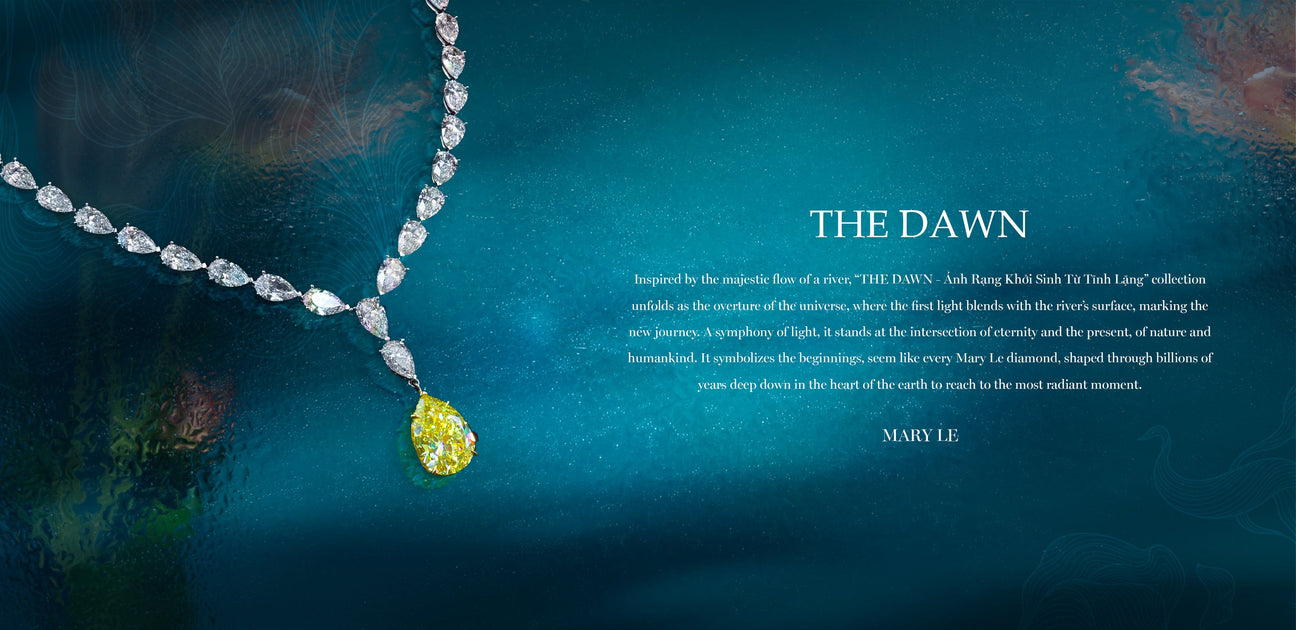
In the High Jewelry segment, for Mary Le , Flawless diamonds represent a choice that emphasizes absolute purity, flawless beauty at the depth of their structure, and luxury defined by the highest standards ever set by the jewelry industry. Finding a Flawless diamond is difficult; incorporating it into a design to showcase its pristine brilliance without disrupting its balance is even more challenging. This is why Flawless diamonds have become a "collector's class," not just a level in a classification system.

Owning Flawless is owning a perfect moment of nature – a beauty that is unrepeatable, irreplaceable, and unmistakable. A statement of aesthetic taste, of uncompromising selection, and of unwavering belief in timeless value.